Call:
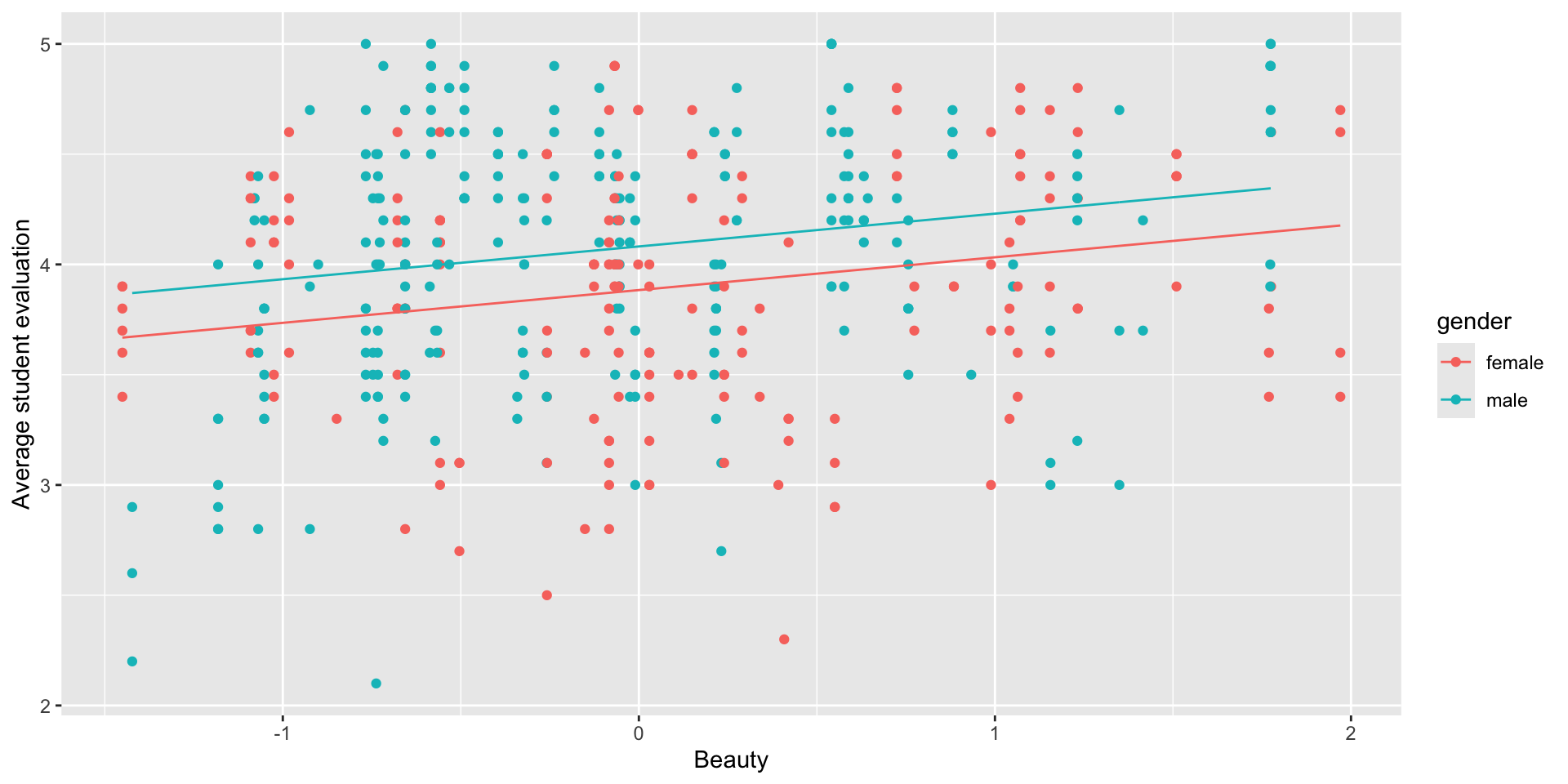
lm(formula = eval ~ beauty * gender, data = profs)

Residuals:
     Min       1Q   Median       3Q      Max
-1.83820 -0.37387  0.04551  0.39876  1.06764

Coefficients:
                  Estimate Std. Error t value             Pr(>|t|)
(Intercept)        3.89085    0.03878 100.337 < 0.0000000000000002 ***
beauty             0.08762    0.04706   1.862             0.063294 .
gendermale         0.19510    0.05089   3.834             0.000144 ***
beauty:gendermale  0.11266    0.06398   1.761             0.078910 .
---
Signif. codes:  0 '***' 0.001 '**' 0.01 '*' 0.05 '.' 0.1 ' ' 1

Residual standard error: 0.5361 on 459 degrees of freedom
Multiple R-squared:  0.07256,   Adjusted R-squared:  0.0665
F-statistic: 11.97 on 3 and 459 DF,  p-value: 0.000000147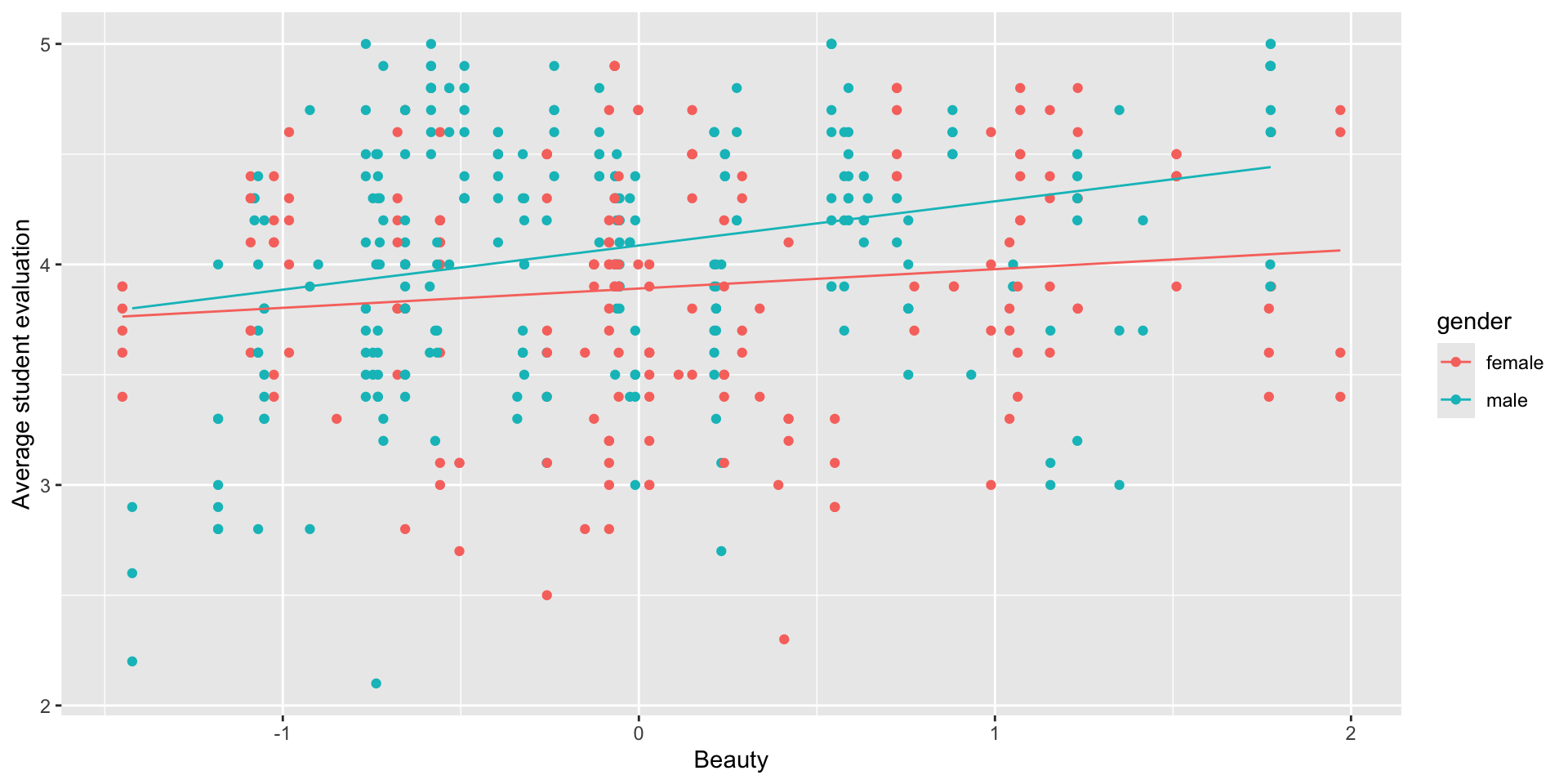
Main effects and interaction effects
In a model with an interaction term \(X_1X_2\), you must also keep the main effects: the variables that are being interacted together.
The main effect of \(X_1\) represents the predicted increase in \(Y\) for a 1-unit change in \(X_1\), holding \(X_2\) constant at zero.
- The main effect
gendermale(0.20) represents the predicted advantage, but only for an average-looking professor (beauty = 0).
- The main effect
beauty(0.09) represents the predicted improvement in evaluation scores for each additional beauty point, but only among women (gendermale = 0).
- The main effect
You can also include other variables in the model that are not being interacted!