Call:
lm(formula = read ~ selection + treatment, data = school)

Residuals:
    Min      1Q  Median      3Q     Max
-35.195  -5.572   1.537   6.617  17.269

Coefficients:
            Estimate Std. Error t value            Pr(>|t|)
(Intercept)  69.7556     1.2697  54.939 <0.0000000000000002 ***
selection    -0.1195     0.2020  -0.592              0.5545
treatment     4.0031     2.1511   1.861              0.0638 .
---
Signif. codes:  0 '***' 0.001 '**' 0.01 '*' 0.05 '.' 0.1 ' ' 1

Residual standard error: 9.135 on 294 degrees of freedom
Multiple R-squared:  0.02237,   Adjusted R-squared:  0.01572
F-statistic: 3.363 on 2 and 294 DF, p-value: 0.03596Data Science for Business Applications
Class 11 - Natural experiments and RDD
The limitations of Randomized Controlled Trials (RCTs)
Although they are powerful for inferring causation, RCTs are hard to pull off:
- They can be incredibly expensive (e.g., Phase 3 clinical trial)
- Compliance with the treatment protocol isn’t perfect (e.g., low-calorie diet, picking up the phone)
- It can be hard to generalize beyond the participants involved in the study if they aren’t representative (e.g., psychology experiments conducted on college students)
- They can be impractical (e.g., effect of education on later earnings) or even unethical (e.g., seatbelts, parachutes, medical trials)
“Faking” randomization
Key idea: Find a comparison group that is effectively “the same as” the treatment group to create a: quasi-experiment or natural experiment.
Does serving in the military affect long-term earnings?
Does serving in the military have an impact upon your long-term earnings after discharge?
Why this won’t work: Compare the wages of people who served in the US military in Afghanistan or Iraq, 10 years after discharge, to the wages of the general public.
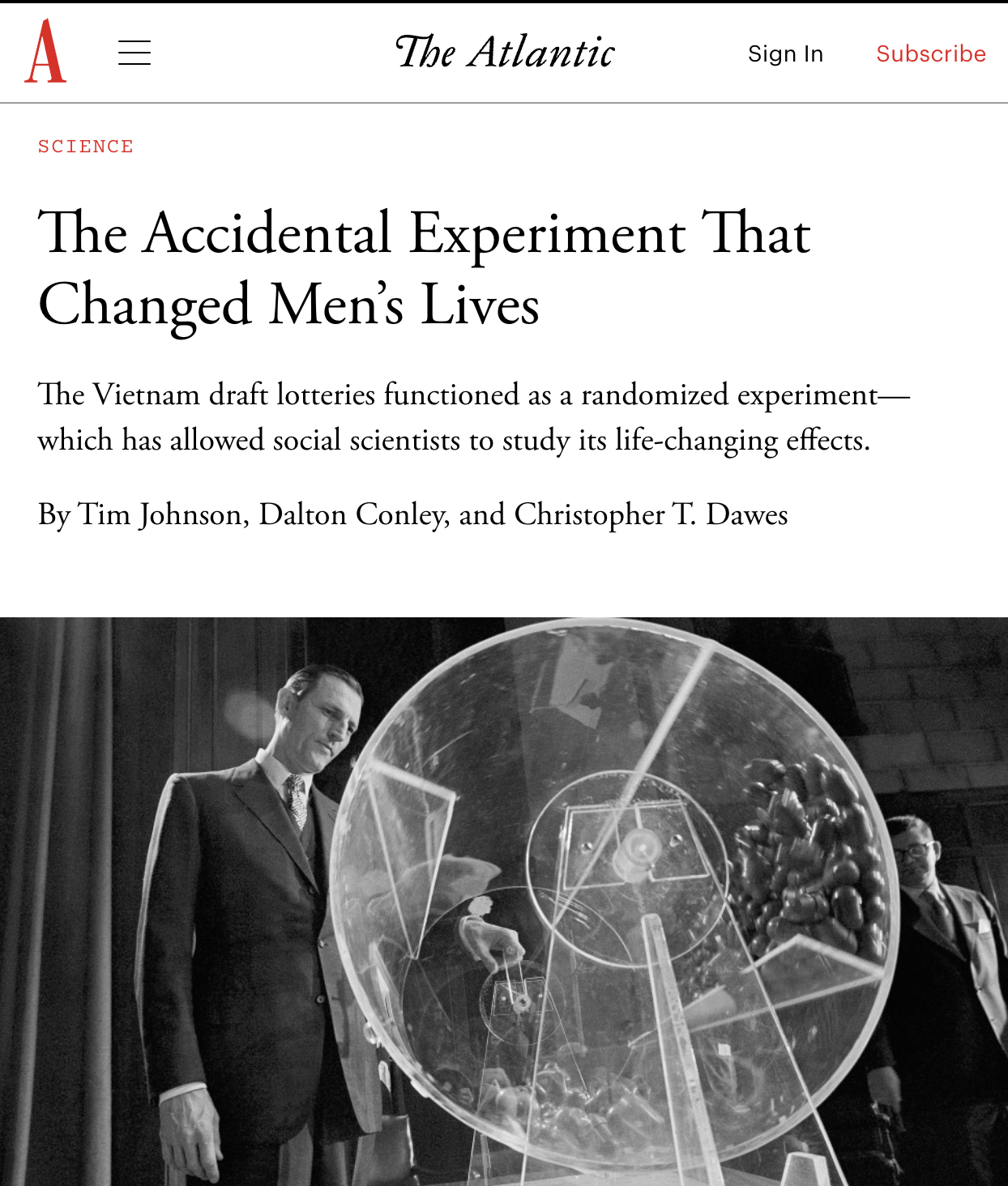
A natural experiment on the effect of military service on earnings
- Angrist (1990) wanted to determine what effect military service had on future earnings
- “Treatment” group: men selected by lottery to serve in Vietnam
“Control” group: men eligible to be drafted but not selected to serve
- We effectively have (almost) random assignment
- This is called a natural experiment because we have discovered something close to an RCT “in the wild”
- For white men, earnings in the 1980s were 15% lower in the treatment group; military service in Vietnam causally reduced long-term earning power
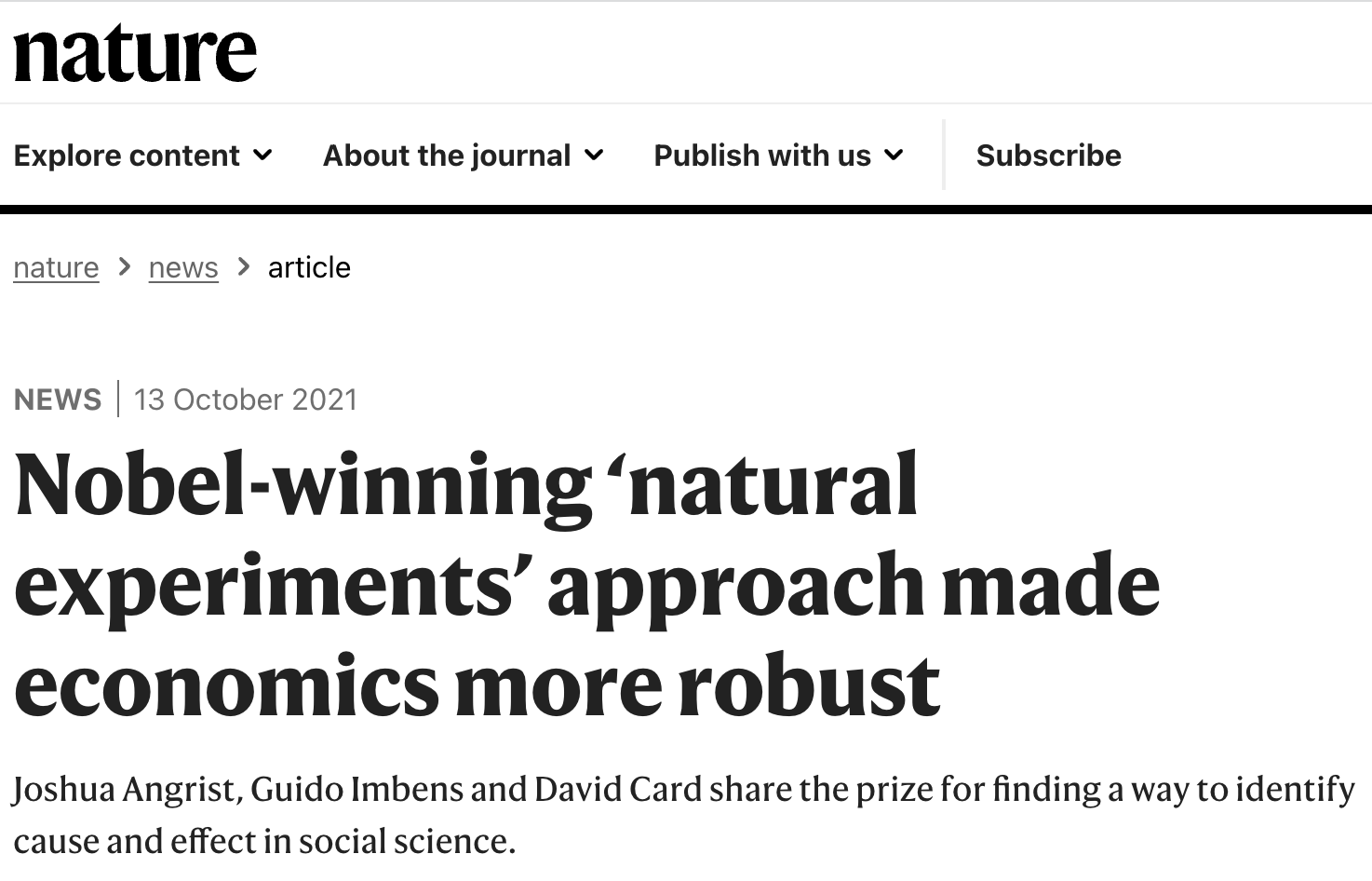
Quasi-experiments / Natural experiments
- These are called quasi-experiments or natural experiments because participants are not randomly assigned to treatment and control groups,
but groups are selected in such a way that the assignment can be thought of as effectively random.
A natural experiment of the minimum wage
Why can’t we just compare the unemployment rate in places with a low minimum wage (e.g., Texas) to places with a high minimum wage (e.g., California)?
Why can’t we just do a randomized controlled trial to study the impact of raising the minimum wage?
A natural experiment of the minimum wage
In 1992, New Jersey’s minimum wage went from $4.25 to $5.05
The minimum wage in Pennsylvania remained at $4.25
Researchers measured employment at 410 fast food restaurants in NJ and PA both before and after the change
This is a natural experiment because the two groups arose naturally (rather than being assigned by the researchers)
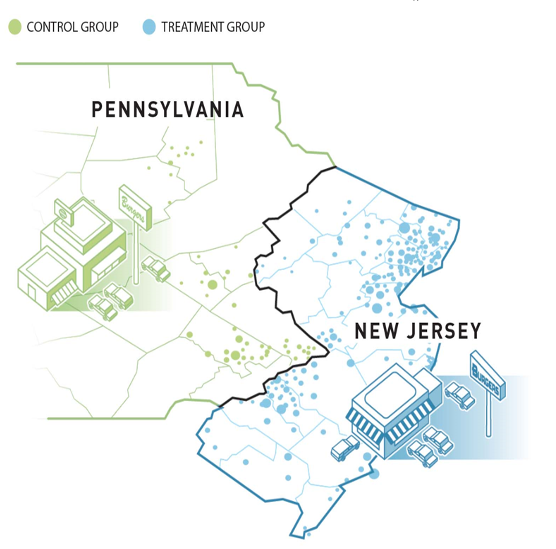
NJ vs PA comparison
| After | |
|---|---|
| Pennsylvania | 21.17 |
| New Jersey | 21.03 |
| Difference | -0.14 |
After the policy change, employment was 0.14 employees per store less in NJ than in PA. Can we interpret this as a causal effect?
No! We cannot distinguish the effect of the minimum wage increase from other differences between PA and NJ.
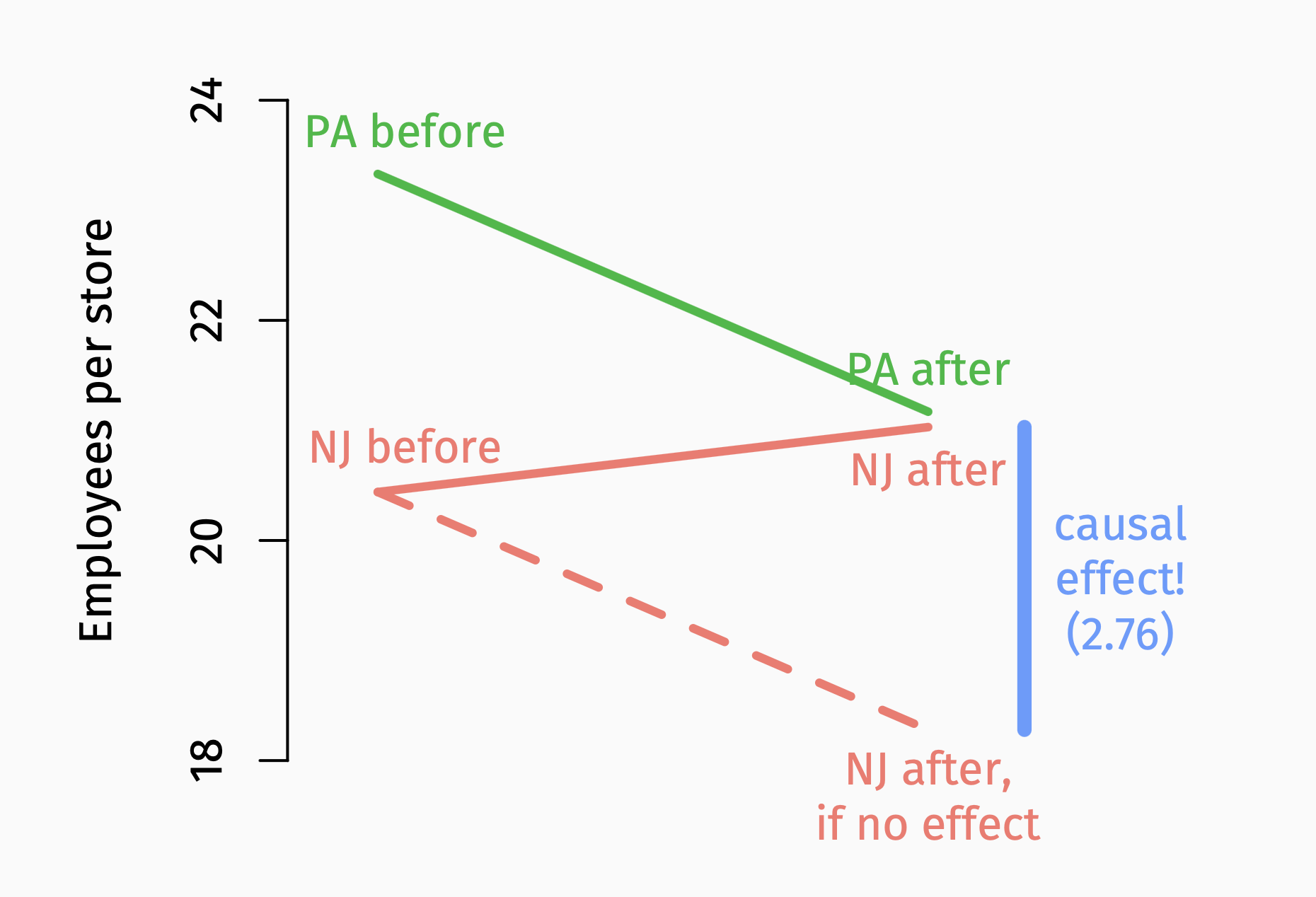
Difference-in-differences
| Before | After | Difference | |
|---|---|---|---|
| Pennsylvania | 23.33 | 21.17 | -2.16 |
| New Jersey | 20.44 | 21.03 | 0.59 |
| Difference | -2.89 | -0.14 | 2.76 |
- The difference of the differences (-0.14-(-2.89) or 0.59-(-2.16)) gives us the causal effect of the policy change.
Ways to create natural experiments
- Geographic boundaries (e.g., NJ vs PA minimum wage example)
- Policy changes (e.g., financial aid policy change example)
- Lotteries (e.g., Vietnam draft lottery example)
- Arbitrary cutoffs
Do flagship state university grads earn more money?
Why can’t we answer this question by comparing average income or wealth of (say) Texas Exes to non-Texas Exes?
Why can’t we do a Randomized Controlled Trial?
Regression discontinuity designs
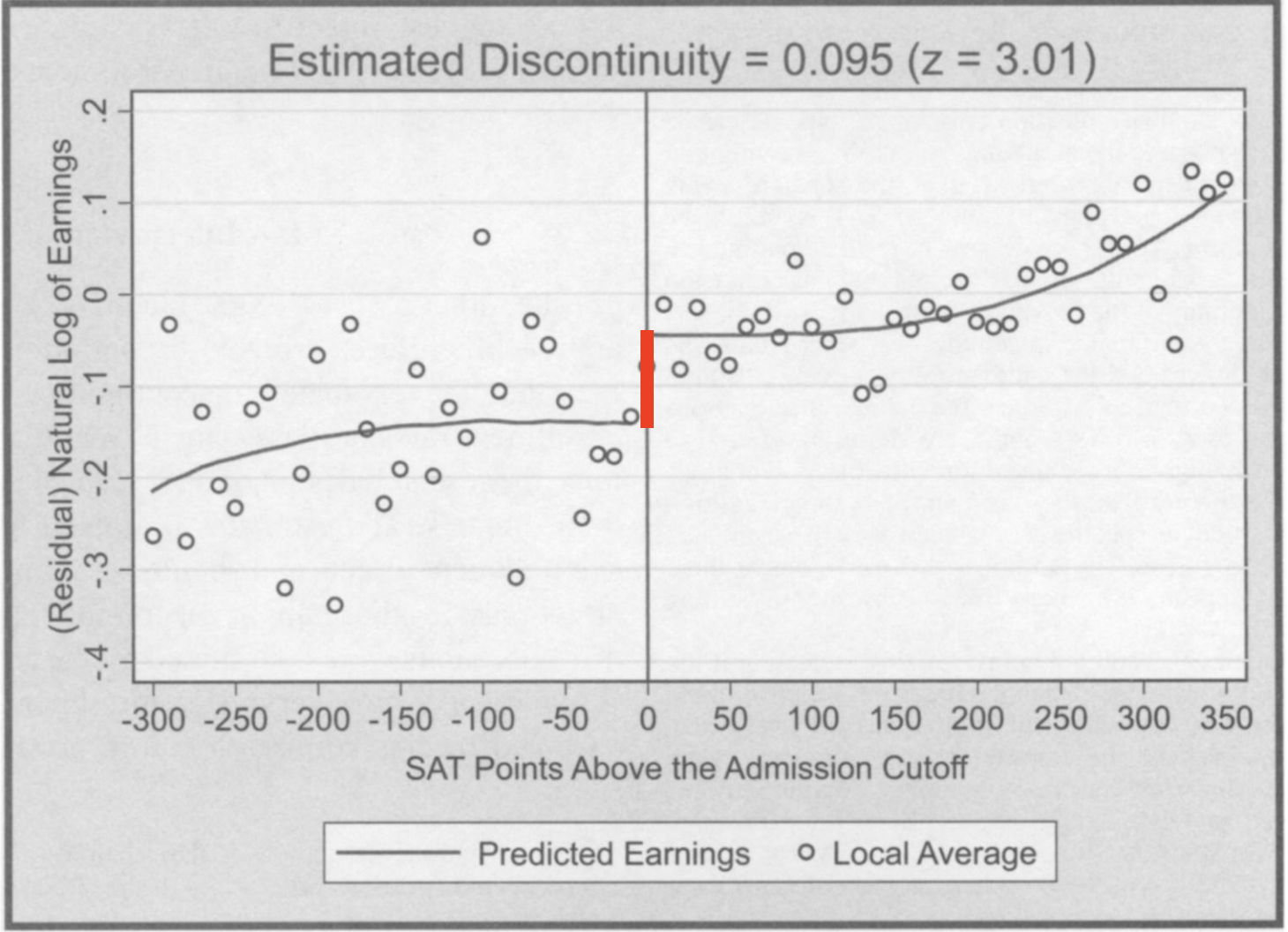
- Hoekstra (2009) studied admission to a state flagship university with an SAT cutoff for admission
- Key idea: Compare earnings 15 years after graduation for students that just made the admissions cutoff (and were accepted)
to those that just missed it (and were rejected)
Regression discontinuity design example
- Build two regressions predicting Y = earnings measure from X = SAT score: one for students below the cutoff and one for students above
- The length of the red line between the curves is the causal effect of admission
Is there a benefit to small class sizes?
- Many people argue that smaller classes lead to better learning outcomes compared to large classes
- But why can’t we just compare test scores of students in small classes and students in large classes?
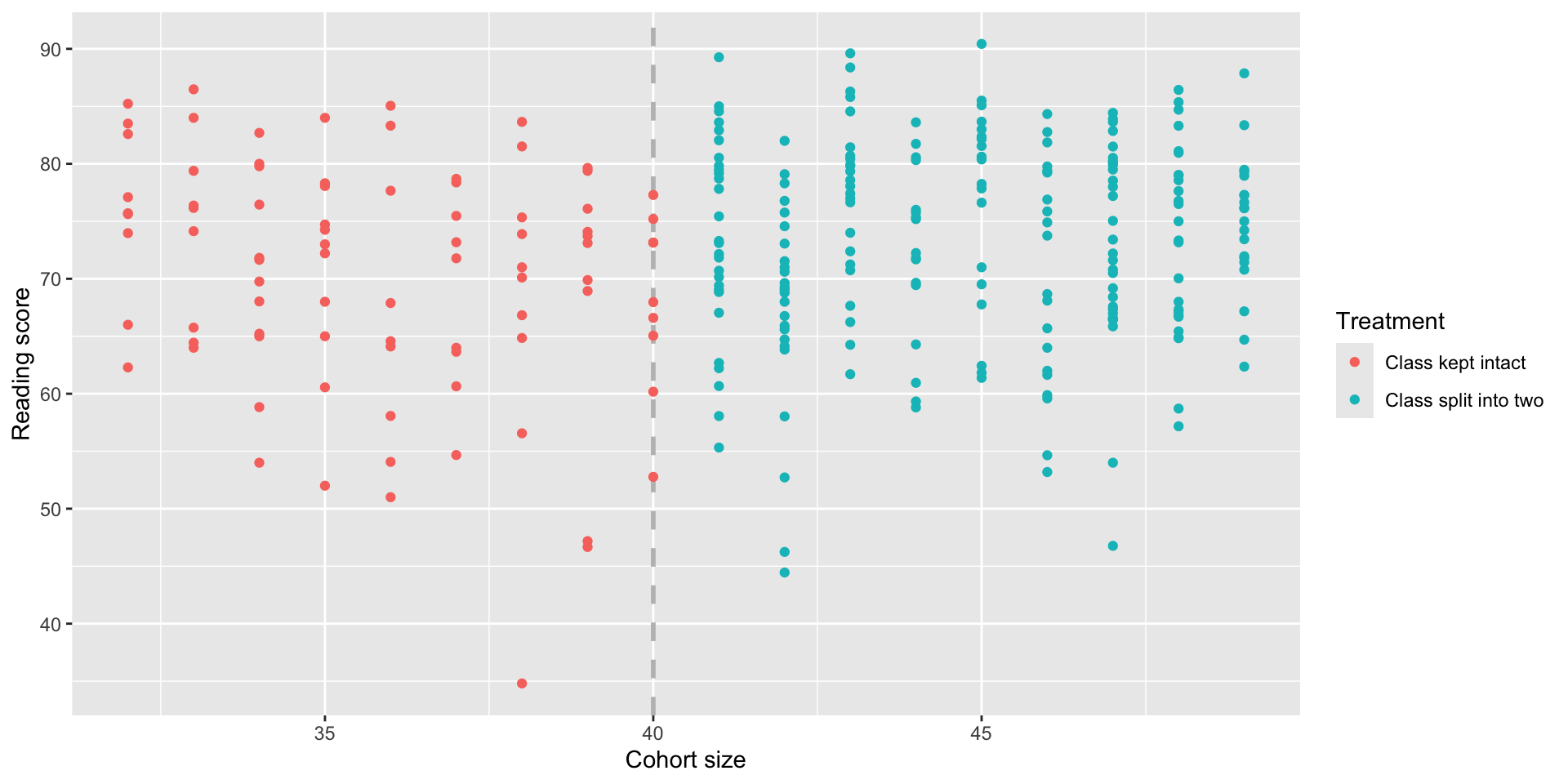
- A study was ran by taking advantage of a rule in a certain schools, where cohorts of >40 students are split into two smaller classes
Is there a benefit to small class sizes?
Key idea: Students in cohorts just below 40 students are essentially identical to students in cohorts just above 40,
but the ones in the latter group will get a smaller class.
Creating the RDD model
Define a treatment variable:
\[ T = \begin{cases} 1, & \text{if the cohort is split into two classes} \\ 0, & \text{if the cohort is kept intact in one class} \end{cases} \]
Recenter the selection variable so the cutoff is at 0:
\[ X = (\text{Cohort size}) - 40 \]
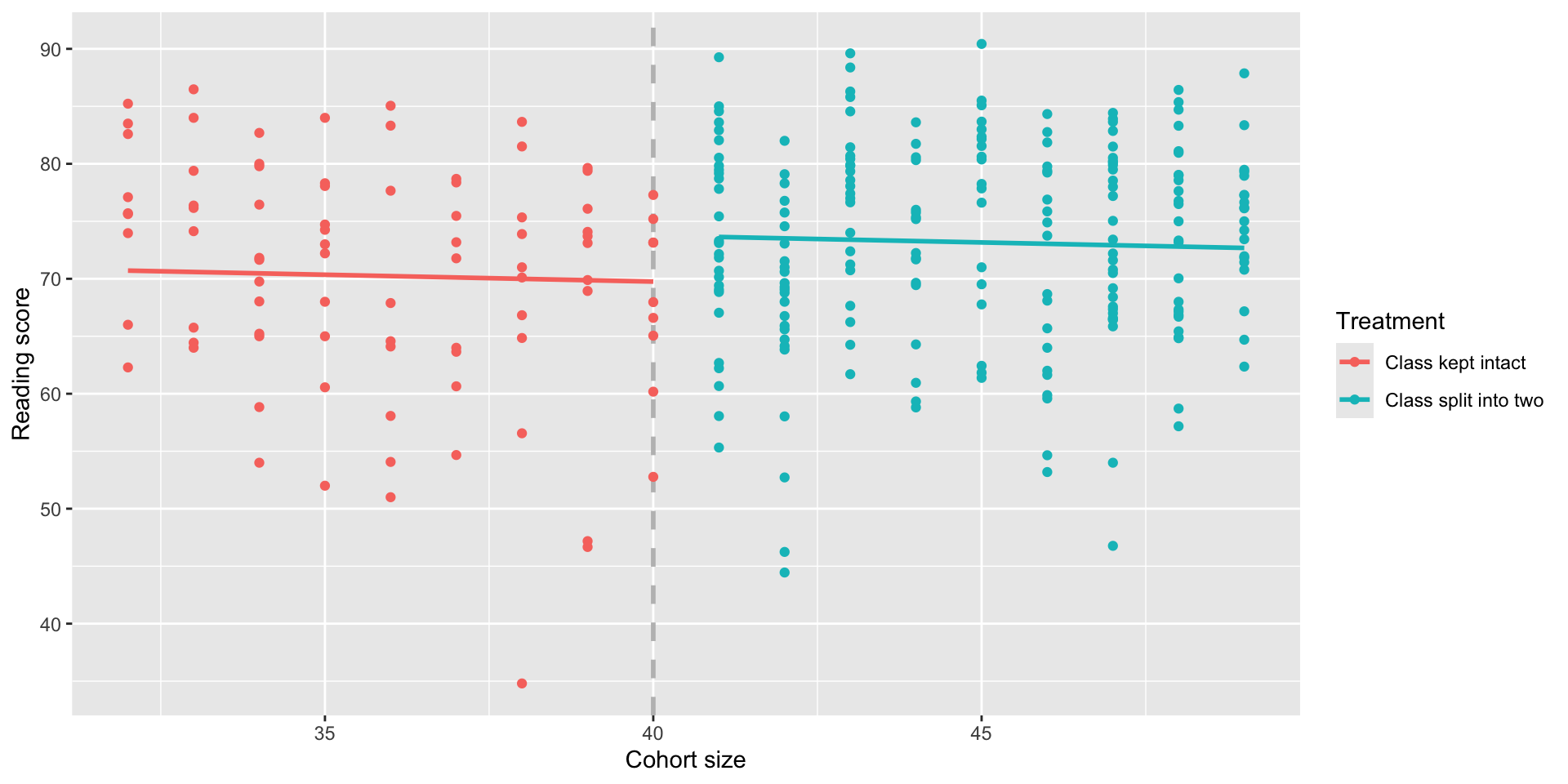
Fit a model predicting reading scores from both (X) and (T):
\[ \hat{Y} = \hat\beta_0 + \hat\beta_1 X + \hat\beta_2 T \]
The coefficient ( _2 ) is the causal effect we’re looking for!
RDD model in R
But wait!
Our first RDD model is forcing the two lines to have the same slope; that isn’t a great fit for the data:
But wait!
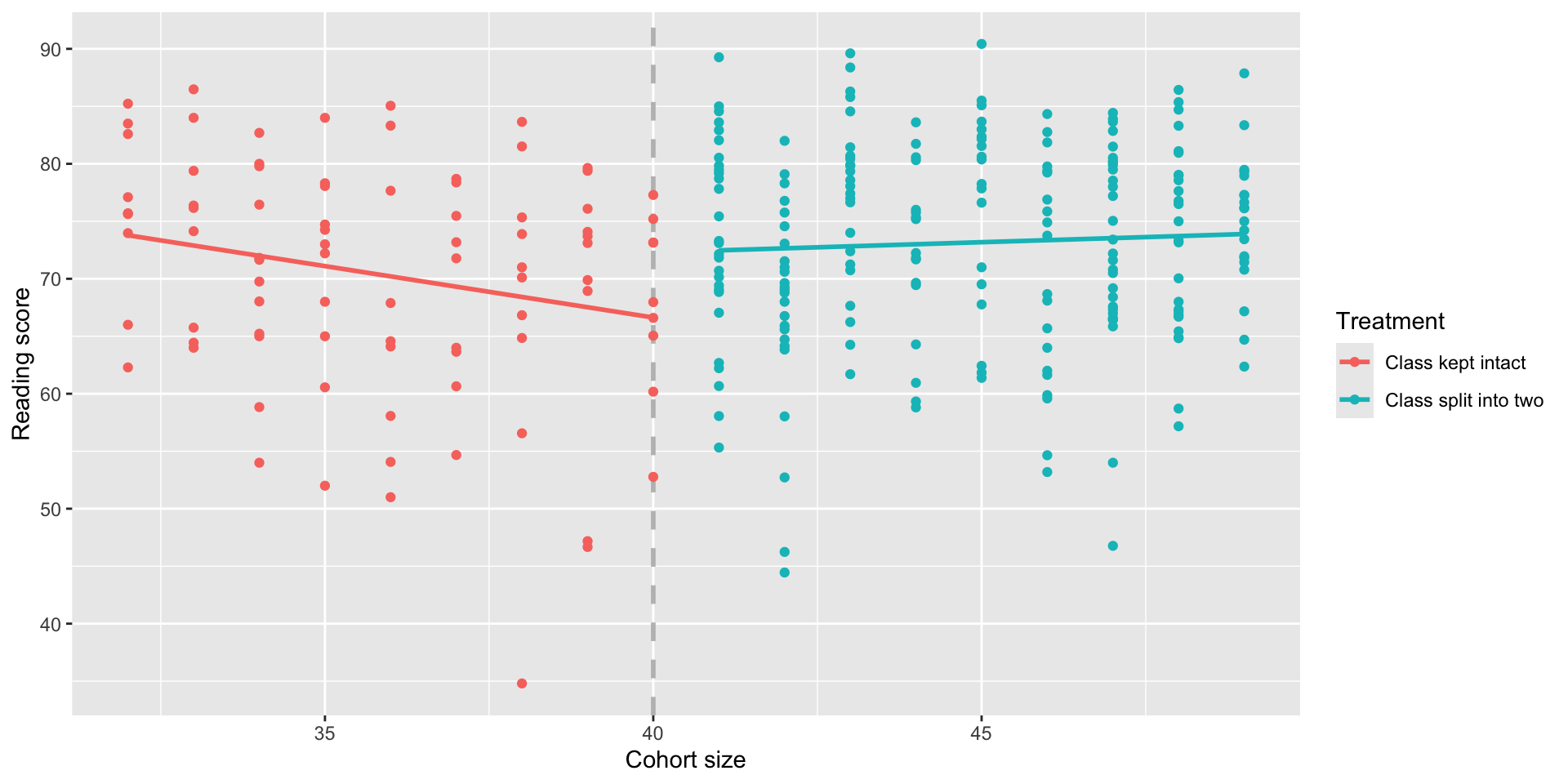
- To allow the two slopes to differ, we can add an interaction term so that the slope of (X) is different for (T=0) (cohort kept intact) and (T=1) (cohort split into smaller classes):
\[ \hat{Y} = \hat\beta_0 + \hat\beta_1 X + \hat\beta_2 T + \hat\beta_3 (T X) \]
- The coefficient on (T) ((_2)) is our estimate of the causal effect of the treatment.
Regression Summary
Call:
lm(formula = read ~ selection * treatment, data = school)

Residuals:
    Min      1Q  Median      3Q     Max
-33.618  -6.102   1.341   6.922  17.249

Coefficients:
                    Estimate Std. Error t value            Pr(>|t|)
(Intercept)          66.6294     1.8141  36.729 <0.0000000000000002 ***
selection            -0.8945     0.3806  -2.350              0.0194 *
treatment             5.6641     2.2439   2.524              0.0121 *
selection:treatment   1.0720     0.4477   2.395              0.0173 *
---
Signif. codes:  0 '***' 0.001 '**' 0.01 '*' 0.05 '.' 0.1 ' ' 1

Residual standard error: 9.063 on 293 degrees of freedom
Multiple R-squared:  0.04113,   Adjusted R-squared:  0.03132
F-statistic:  4.19 on 3 and 293 DF,  p-value: 0.00634
A better RDD model
Conclusion
From our data we can conclude that smaller class sizes cause reading scores to increase by about 5.7 points.
RDD is usually great for internal validity, but there are many threats to external validity: e.g., would this generalize to different grade levels? Schools outside of the one in the study?
